SSS pays a daily cash allowance when sickness or injury keeps you from working and you are confined, at home or in hospital, for at least 4 days. You need at least 3 monthly contributions in the 12 months before the semester you got sick. The allowance is 90% of your average daily salary credit, for up to 120 days in a calendar year (RA 11199 Sec. 14).
Who qualifies
Check each of these against the SSS sickness benefit page:
- You cannot work because of sickness or injury, and you are confined at home or in hospital for at least 4 days.
- You paid at least 3 monthly contributions in the 12 months before the semester of sickness. For self-employed, voluntary and OFW members, SSS counts only contributions paid before that semester, so paying late to catch up does not help.
- You notified your employer (if employed) or SSS directly (if self-employed, voluntary, an OFW or separated from work).
- If employed, you have used up your paid sick leave for the year. Sea-based OFWs are the exception.
A “semester” here means two quarters in a row, ending with the quarter you got sick. If you fell ill in August, the semester is April to September, so SSS looks at your contributions from April of the year before to March.
How the allowance is worked out
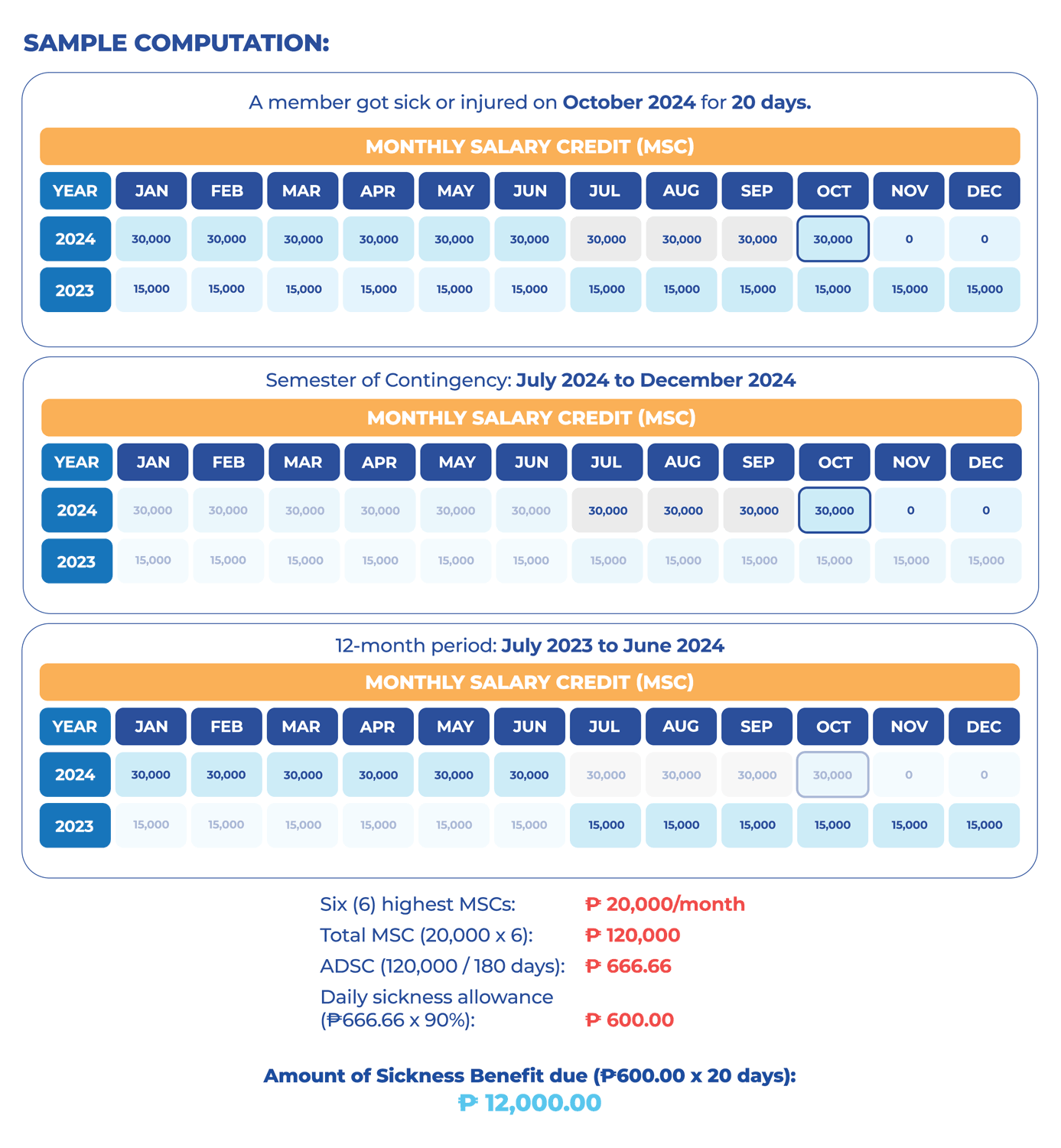
SSS uses your average daily salary credit (ADSC). RA 11199 Sec. 8(n) defines it as the six highest monthly salary credits in the 12 months before the semester of sickness, added up and divided by 180. Each salary credit counts only up to PHP 20,000. Above that, your contributions go to your MPF account, not to this benefit.
SSS’s own sample on its sickness page is a member whose salary credits are PHP 30,000, capped at PHP 20,000 for the benefit, sick for 20 approved days:
- Six highest salary credits, each capped
- PHP 20,000
- Total of the six (20,000 x 6)
- PHP 120,000
- Average daily salary credit (120,000 / 180)
- PHP 666.66
- Daily sickness allowance (90%)
- PHP 600.00
- Benefit for 20 days
- PHP 12,000.00
Because of the cap, PHP 600 is the most the daily allowance can be. A member with lower salary credits gets less: the same steps with your own six highest credits give your figure.
Filing: employees, and OFW, voluntary and self-employed members
Who tells whom, and by when, is the part most claims go wrong on. These deadlines are from the SSS sickness page. “Member to SSS” means self-employed, voluntary, OFW and separated members, who deal with SSS directly:
| Who tells whom | Home confinement | Hospital confinement |
|---|---|---|
| Employee to employer | Within 5 calendar days after it starts | Not needed |
| Employer to SSS | Within 5 calendar days of hearing from you | Within 1 year of your discharge |
| Member to SSS | Within 5 calendar days after it starts | Within 1 year of your discharge |
Scroll the table sideways for more
For self-employed, voluntary and OFW members, filing the sickness benefit application in My.SSS counts as the notice to SSS (SSS Circular 2023-008). If you notify late, SSS treats the confinement as starting no earlier than the fifth day before your notice, so you lose the days before that.
If you are employed, your employer pays the allowance first, on your regular paydays, and SSS reimburses the employer in full. The allowance starts only after your paid sick leave runs out (RA 11199 Sec. 14(b) and (c)).
If you are self-employed, voluntary, an OFW, a non-working spouse or separated from work, SSS pays you directly.
How to file online
Self-employed, voluntary, OFW and separated members file through My.SSS. Before you start, you need a My.SSS account and an approved disbursement account in the Disbursement Account Enrollment Module (DAEM), since that is where SSS sends the money (SSS Circular 2021-019).
- Log in to your My.SSS account.
- Open the Benefits tab and choose Sickness Benefit.
- Fill in the online application form and click Next.
- Upload your documents and click Next.
- Review the details, tick the certification box and submit.
- Note your transaction number. SSS’s Medical Evaluation Center reviews the claim and emails you the result.
Documents:
- The SSS Medical Certificate (form Med 01688), with the full diagnosis, the recommended days of sick leave including recovery, and the doctor’s clinic address, contact number and licence number.
- Supporting medical records if you were confined for a long time: laboratory, X-ray, ECG or other test results, or the operating room record.
- If you got sick abroad, documents from the foreign country need an English translation, authenticated by the Philippine Embassy or Consulate, or notarised in that country.
- If you left a job recently, a certificate of separation from your employer showing the date you left and that no advance was paid.
The 2026 SSS Citizen’s Charter gives 20 working days to process a sickness claim filed by an individual member. Payment goes to your enrolled account.
If illness has stopped your income, we can talk through what it means for your savings.
Talk through your income planIf the illness lasts longer
SSS pays sickness benefit for at most 240 days for the same illness. If it goes on past that, SSS treats the claim as a disability claim. Days you do not use in one calendar year do not carry over to the next. The SSS disability benefit guide covers what comes next. If you receive the maternity benefit, you cannot also get sickness benefit for the same days. For the full list of what SSS covers while you work, see the SSS guide for OFWs.
Questions people ask
How many days do I have to claim the SSS sickness benefit?
It depends on where you were confined. For confinement at home, notify SSS (or your employer, if employed) within 5 calendar days after it starts. For a hospital stay, you have 1 year from the day you were discharged. If you notify late, SSS counts your confinement from no earlier than 5 days before the date you notified.
How do I calculate my SSS sickness benefit?
Leave out the semester you got sick. In the 12 months before it, add your 6 highest monthly salary credits, counting each up to PHP 20,000. Divide by 180 to get your average daily salary credit. Take 90% of that for the daily allowance, then multiply by the number of approved sick days.
How do I file the SSS sickness benefit?
If you are employed, tell your employer and give them the SSS medical certificate; your employer pays you and files for reimbursement. If you are self-employed, voluntary, an OFW or no longer employed, file it yourself in My.SSS under Benefits, then Sickness Benefit, and upload the medical certificate.
How much do I claim for SSS sickness benefit?
90% of your average daily salary credit for each approved day. SSS counts salary credits only up to PHP 20,000, so the daily allowance cannot go above PHP 600. You can be paid for up to 120 days in a calendar year.
Who is eligible for SSS sickness benefit?
From the SSS sickness benefit page: a member who cannot work because of sickness or injury and is confined at home or in hospital for at least 4 days, who has paid at least 3 monthly contributions in the 12 months before the semester of sickness, who has notified the employer or SSS, and, if employed, who has used up the year's paid sick leave.
Talk it through
Talk through your income plan with usSources
- SSS sickness benefit page (checked 20 October 2026)
- RA 11199, Social Security Act of 2018, Secs. 8(n) and 14 (checked 20 October 2026)
- Implementing rules of RA 11199, Rule 25 (checked 20 October 2026)
- SSS sample sickness computation (image) (checked 20 October 2026)
- SSS Circular 2021-019, online filing of sickness claims (PDF) (checked 20 October 2026)
- SSS Circular 2023-008, notification and filing periods (PDF) (checked 20 October 2026)
- SSS Citizen's Charter 2026, 1st edition (PDF) (checked 20 October 2026)